
Define the finished product first
Thermal jumbo rolls are parent stock for converting equipment. They are not finished rolls intended to fit a point-of-sale printer. Start with the receipt or other finished product you want to produce, its dimensions and its performance requirements.
Provide the converting process and equipment limits. A suitable incoming roll must work with the unwinder, slitter and rewinder as well as the finished product specification. Similar product names are not proof that two grades or formats are interchangeable.
Specify grammage and grade
Record the required grammage in grams per square metre and identify the grade where known. Include caliper if the converting process or finished-roll design depends on thickness. Grammage alone cannot predict the length that will fit within a given finished-roll diameter.
For thermal material, identify coating and imaging requirements. Ask for documentation for the actual proposed grade if the application requires a chemical declaration, durability claim or other specific property. Do not transfer a claim from a different manufacturer's sheet to an unspecified grade.
Match web width to the slitting plan
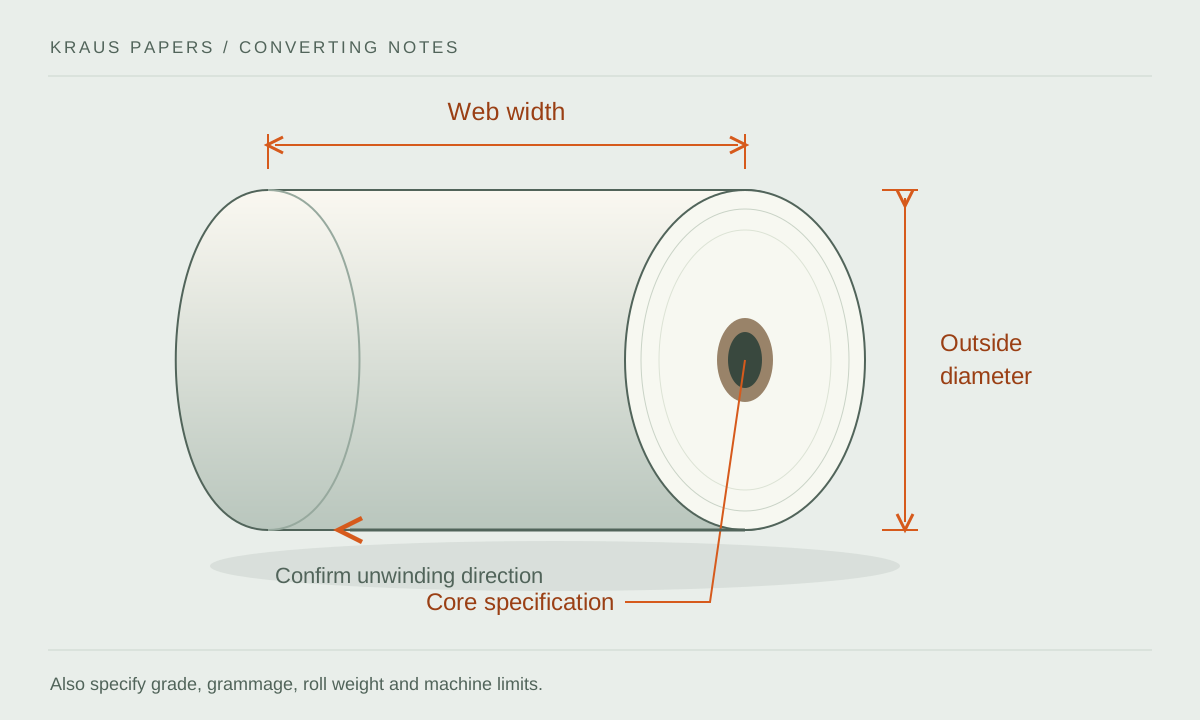
Web width is the width of the incoming sheet of paper wound on the roll. Provide the required width and tolerance, together with the intended finished widths. The converting operator should confirm the slitting layout and any allowance for edge trim.
For example, the total of the finished widths alone does not establish the required parent width if the process also needs trim or other allowances. Agree the layout against the machine and process specification rather than assuming every theoretical combination is practical.
Confirm roll geometry and weight limits
Record maximum outside diameter, core inside diameter and any core construction requirements. Include maximum permissible roll weight and any restrictions imposed by the chuck, shaft or lifting arrangement.
A roll can meet the width requirement but exceed a weight or diameter limit. Check each constraint independently. Roll length, diameter and mass are related to material properties and core dimensions; obtain the values needed for the order rather than substituting one for another.
Describe winding and coating orientation
State how the roll must unwind and which side must face the relevant part of the process. Use a drawing or a clear orientation reference when words such as inside, outside, left and right could be misunderstood.
Include any requirements for winding tension, splice handling, edge quality and tolerances from the machine or quality specification. These must be agreed with the proposed supply; a general catalogue listing does not guarantee a particular converting limit.
Plan receiving, handling and approval
Confirm that the receiving site can unload and handle the proposed roll dimensions and mass using suitable equipment and trained personnel. Agree protective packing, storage guidance and the information needed on roll labels. This guide does not replace the equipment manufacturer's safety instructions or your site procedures.
Where process performance is critical, ask what samples or trial arrangements can be provided. Agree how the grade and trial results will be approved before a larger order. Availability of samples, documents or a specific grade must be confirmed.
Agree quotation units and required information
- Finished product and converting process.
- Grade, grammage, caliper and relevant documentation.
- Web width, tolerances and slitting layout.
- Core requirements, outside diameter and maximum roll weight.
- Winding direction and coating orientation.
- Order quantity, packing and receiving constraints.
- Quotation unit, such as mass or rolls, and what the stated quantity includes.
Keep required limits separate from measured examples. Include machine documentation where possible and identify unknown values. A quotation should resolve the actual available specification, minimum quantities and delivery arrangements before an order is agreed.