
Start with the printer specification
A replacement receipt roll needs to fit both the printer mechanism and its paper compartment. Begin with the printer make, model and media specification. An old roll can help you describe what you use, but it may not represent the maximum dimensions the printer supports.
Check the required printing process. A receipt printer that requires thermal media is different from an impact printer using a ribbon. For labels, also check the gap or black-mark sensor and label dimensions. This guide covers the physical measurements of a continuous receipt roll; it does not certify compatibility with a particular printer.
Measure width across the paper
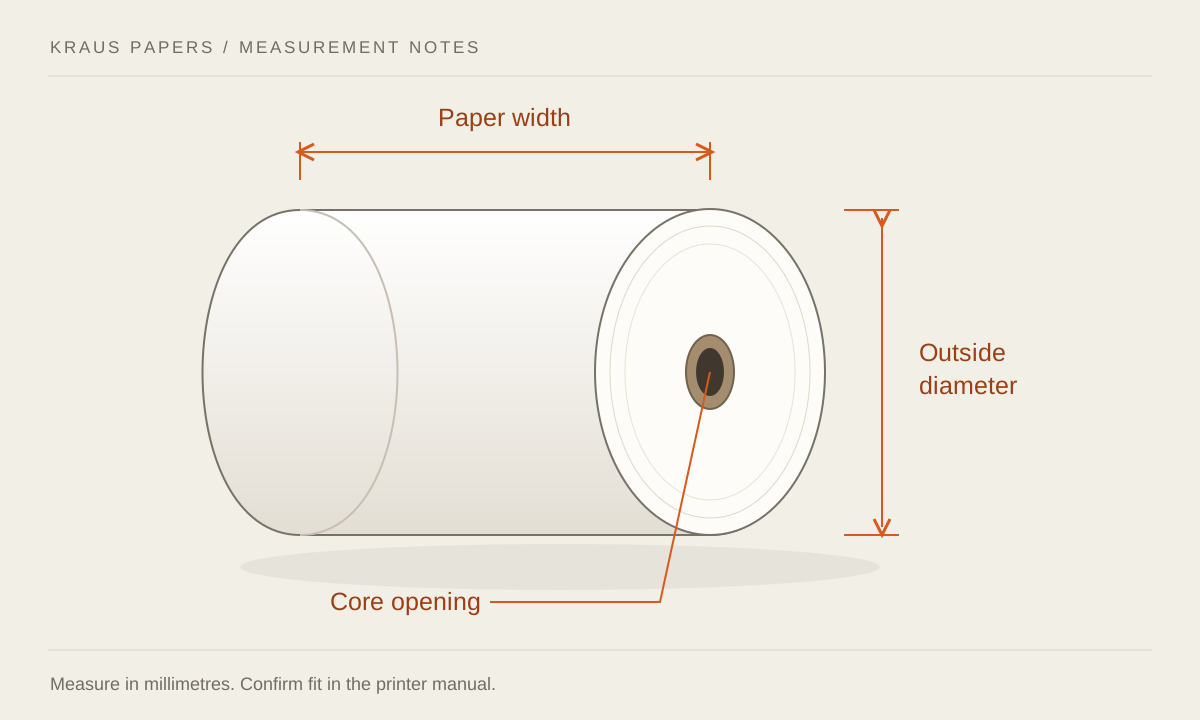
Width is the distance from one edge of the paper to the other, across the roll. Measure straight across, not diagonally, and record the unit in millimetres. Avoid including protruding core material in the paper-width measurement.
Use the printer manual to determine acceptable width and tolerances. Two rolls with the same nominal width may have different outside diameters or cores. Do not choose a replacement from width alone.
Measure the outside diameter
The outside diameter is the distance across the full circular face of the roll, through its centre. Measure a new or full roll where possible. A partly used roll will understate the original diameter.
Compare the result with the maximum permitted by the printer. A roll that is too large may prevent the cover from closing or interfere with feeding. Do not force a roll into the compartment. Record whether your measurement describes an existing roll or a maximum equipment limit.
Check the core and mounting arrangement
Measure the opening through the centre of the core: this is the core inside diameter. If the equipment specification also gives an outside core diameter or spindle requirement, record that separately. Check whether the printer uses a spindle, drop-in loading or another mounting arrangement.
Do not assume that an apparently coreless roll can replace a cored roll, or the reverse. The printer manufacturer's loading instructions take precedence. Include a photograph or the media specification when the mounting arrangement is unclear.
Treat length and paper grade separately
Roll length describes the amount of paper, not the diameter. The same outside diameter can contain different lengths when paper thickness or core dimensions differ. Ask for the actual quoted length rather than estimating it from a photograph or roll diameter.
Grammage measures mass per area; it is not the same measurement as caliper, which describes thickness. Ask which grade is being quoted and request supporting documentation for chemical composition or image-life requirements. A generic thermal-paper description does not establish those properties.
Confirm loading and storage requirements
Check the required winding and printable side against the printer instructions. Loading media the wrong way can prevent a usable image even when the physical dimensions fit. Test the proposed grade and settings before placing a substantial production order.
Keep unused rolls in their protective packaging and follow the grade's handling guidance. Heat, sunlight and contact with unsuitable substances can affect thermal media. Where receipts need to remain legible for a defined period, agree the requirement and obtain grade-specific evidence.
Prepare a useful enquiry
- Printer make and model, with the media specification if available.
- Paper width and maximum outside diameter in millimetres.
- Core inside diameter, any outside core limit and loading arrangement.
- Required roll length, grade and winding information.
- Number of rolls, preferred packing and intended use.
- Any documented chemical or image-retention requirements.
Distinguish measured values from requested limits. If a dimension is unknown, identify it as unknown so it can be discussed. Available sizes, packing and quantities are confirmed in the quotation; this checklist is not a list of stocked variants.